
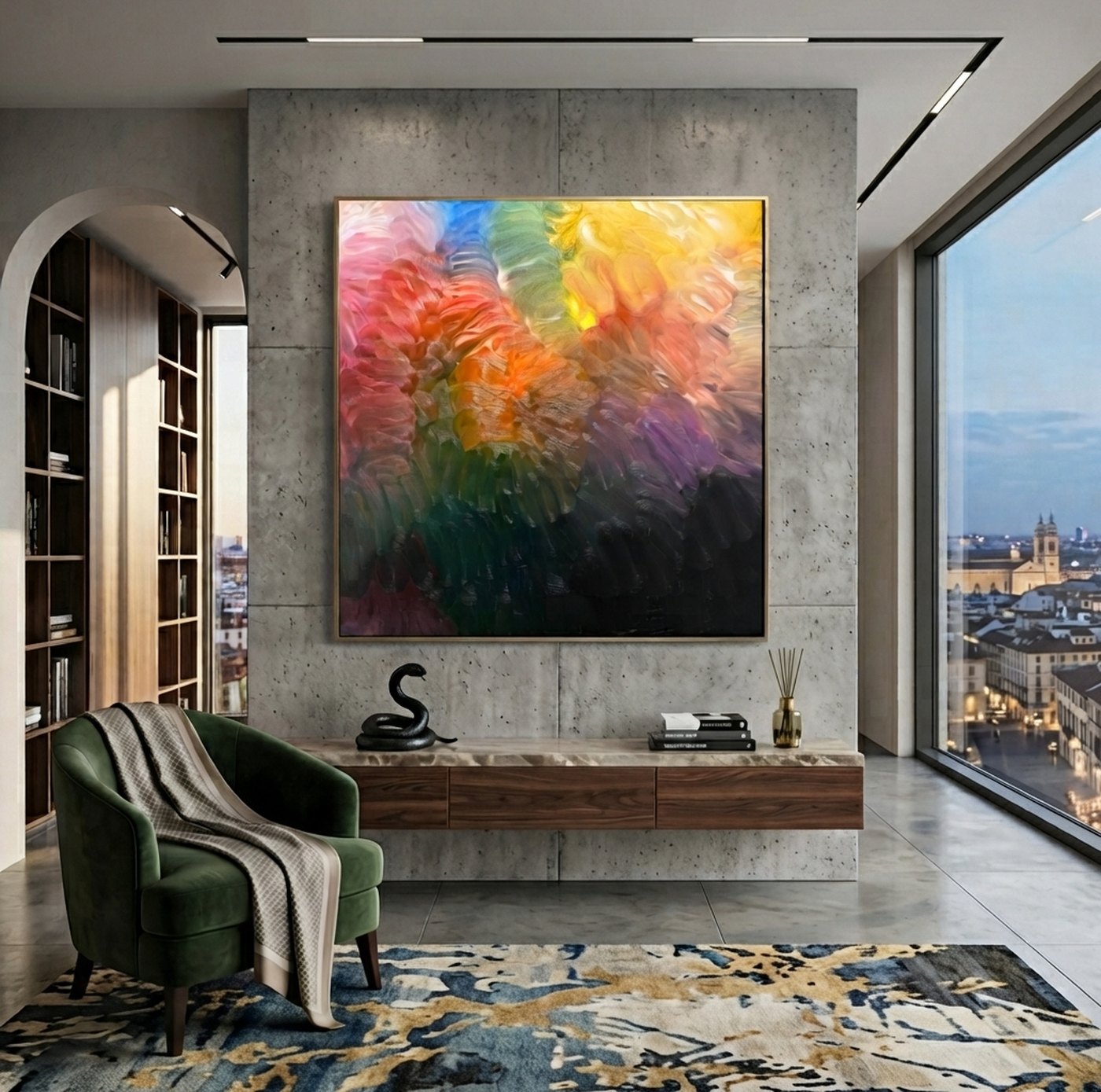
Untitled n°118
AvailableThe painting belongs to the family of the artist's other works in spirit, but speaks a different grammar — one closer to music than to atmosphere.
Where the other canvases breathe, this one counts. The surface is built as a continuous procession of small, looped brushstrokes — each one curved, each one identical in rhythm, each one a small unit of pressure inscribed by the same hand. The strokes arrange themselves into diagonal bands of color, succeeding one another like measures in a score: a pale pink at the upper left, then a blue, a green, a yellow, a warm ochre, a luminous mother-of-pearl — descending finally into a deep, gathered black at the lower right.
The work proposes a chromatic counterpoint. No color dominates, none recedes; each is given exactly the space necessary for the eye to register its presence before yielding to the next. The painting reads, in this sense, as a slow horizontal scale — a passage of tones executed with the patience of someone who knows that beauty, like music, lives in the precision of the interval.
There is something tactile in the result. The repeated stroke gives the canvas the quality of woven matter — closer to silk, to brocade, to the surface of an instrument's resonating wood than to traditional painting. The eye does not look at the work; it follows it, the way a hand follows the texture of a finely made object.
In a body of work largely concerned with dissolution and slow atmosphere, this painting introduces a different register: order, measure, the quiet authority of rhythm. It reminds the viewer that calm is not only achieved through softness — it can also be reached through the disciplined repetition of a single, beautiful gesture.
Il dipinto appartiene per spirito alla famiglia delle altre opere dell'artista, ma parla una grammatica diversa — più vicina alla musica che all'atmosfera.
Dove le altre tele respirano, questa conta il tempo. La superficie è costruita come una processione continua di piccole pennellate ad anello — ciascuna curva, ciascuna identica nel ritmo, ciascuna una piccola unità di pressione tracciata dalla stessa mano. Le pennellate si dispongono in bande diagonali di colore, susseguendosi come misure di uno spartito: un rosa pallido in alto a sinistra, poi un blu, un verde, un giallo, un ocra caldo, una madreperla luminosa — per scendere infine in un nero profondo e raccolto in basso a destra.
L'opera propone un contrappunto cromatico. Nessun colore domina, nessuno arretra; a ciascuno è dato esattamente lo spazio necessario perché l'occhio ne registri la presenza prima di cedere al successivo. Il dipinto si legge, in questo senso, come una lenta scala orizzontale — un passaggio di toni eseguito con la pazienza di chi sa che la bellezza, come la musica, vive nella precisione dell'intervallo.
C'è qualcosa di tattile nel risultato. La pennellata ripetuta conferisce alla tela la qualità di una materia tessuta — più vicina alla seta, al broccato, alla superficie del legno armonico di uno strumento che alla pittura tradizionale. L'occhio non guarda l'opera; la segue, come una mano segue la texture di un oggetto finemente lavorato.
In un corpus in gran parte dedicato alla dissoluzione e all'atmosfera lenta, questo dipinto introduce un registro diverso: ordine, misura, la quieta autorità del ritmo. Ricorda a chi guarda che la calma non si raggiunge soltanto attraverso la morbidezza — la si può raggiungere anche attraverso la ripetizione disciplinata di un unico, bellissimo gesto.